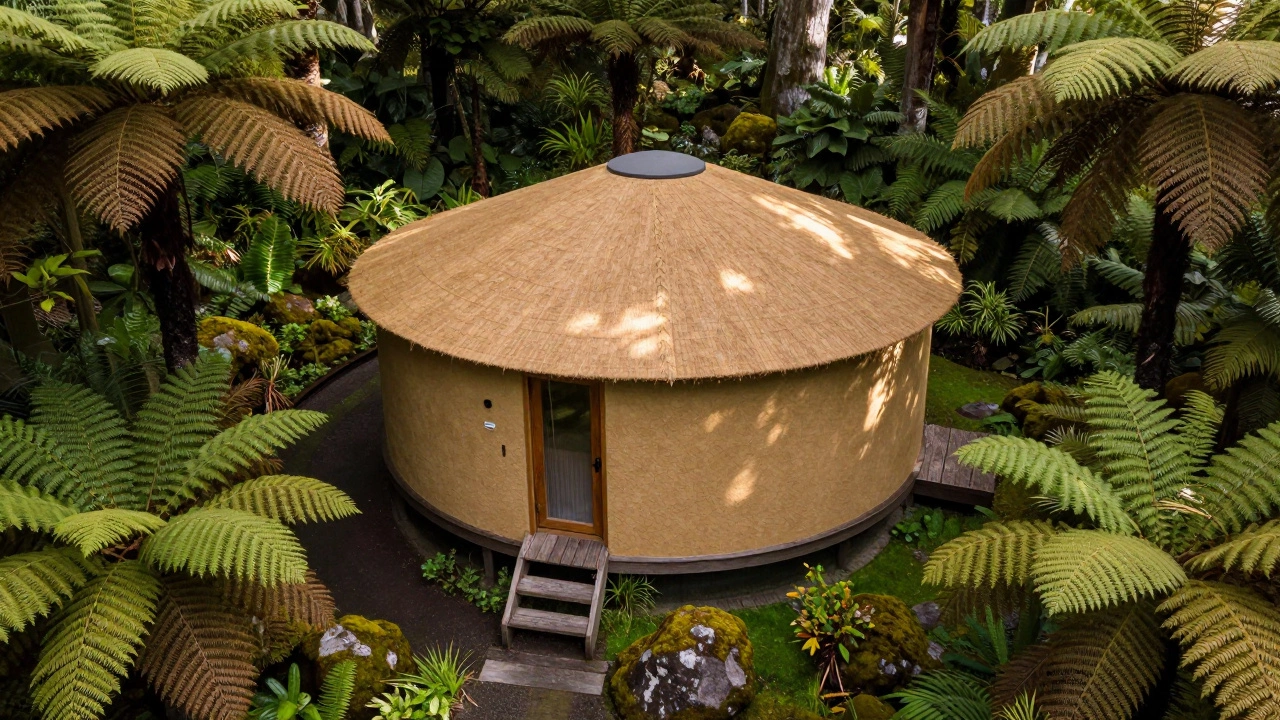
House Shape Energy Calculator
See how different house shapes affect your energy bills and construction costs. Based on real-world data from eco-friendly cottages in New Zealand.
Your Inputs
Comparison
| Shape | Surface Area Efficiency | Energy Savings vs. Rectangle | Material Savings |
|---|---|---|---|
| Round | Best (100%) | 25-30% | 15-20% |
| Hexagon | Very Good (90%) | 18-22% | 12-17% |
| Octagon | Good (85%) | 15-18% | 10-15% |
| Rectangle | Poor (Baseline) | 0% | 0% |
When you’re building an eco-friendly cottage, the shape of the house might seem like a design choice-but it’s actually one of the biggest factors in how much it costs to build and run. Forget fancy angles or sprawling layouts. The most economical house shape isn’t about looks. It’s about physics. And the winner? The round house.
Why shape matters more than you think
Most people focus on materials when they want to save money on a cottage. Solar panels, insulation, reclaimed wood-all important. But they miss the biggest leak: surface area. Every square meter of exterior wall is a place where heat escapes in winter and heat enters in summer. The less surface area you have for the same floor space, the less energy you need to heat or cool it. A square or rectangular house has four walls, sharp corners, and a lot of exposed surface. A round house? It has one continuous wall with no corners. That means less material to buy, less labor to build, and less energy to waste. Studies from the University of British Columbia show that a circular home with the same floor area as a rectangular one can reduce exterior wall surface by up to 26%. That’s not a small difference-it’s the difference between a $1,200 heating bill and a $900 one in a cold New Zealand winter.How a round house cuts costs from the ground up
Building a round house isn’t just about saving on energy bills. It saves money at every stage.- Less material: A circle encloses the most space with the least perimeter. For a 100-square-meter home, a round design uses about 15-20% less wall material than a square one. That means fewer bricks, less timber, less siding.
- Faster construction: No complex roof angles, no intersecting walls, no awkward corners to frame. Prefabricated curved panels or rammed earth walls can go up quicker. In rural Devonport, builders who’ve done both report round cottages taking 3-5 days less to enclose than comparable rectangular ones.
- Stronger structure: Round shapes handle wind and seismic forces better. In coastal areas like ours, where storms roll in from the Tasman Sea, a dome or circular design naturally deflects wind instead of catching it. That means fewer repairs over time.
- Less waste: Building materials like timber, concrete, and insulation are cut more efficiently in circular layouts. There’s no need to trim odd angles or throw out leftover pieces.
What about the roof? The key to efficiency
The roof is just as important as the walls. A dome-shaped or low-pitched round roof is the most efficient. It sheds rain and snow evenly, avoids snow buildup in corners, and requires less roofing material than a gabled roof covering the same space. A hemispherical dome, for example, uses 30% less roofing material than a traditional pitched roof on a square house of equal floor area. And because the roof and walls flow into one another without corners, there’s no place for water to pool or leak. That’s why many off-grid eco-cottages in Tasmania and New Zealand’s West Coast use domed designs-they’ve been tested in decades of rain and wind.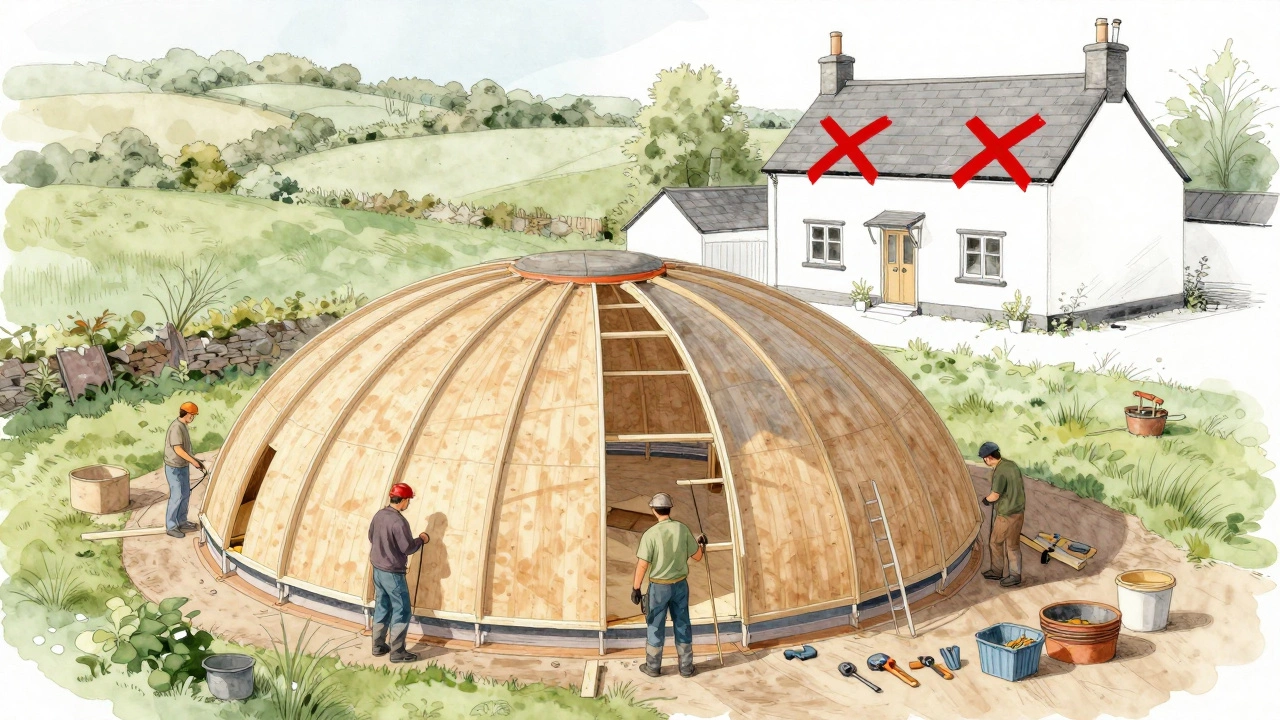
Real-world examples that prove it
You don’t have to take my word for it. Look at the Earthship homes in Taupō-built with recycled tires and earth-packed walls, shaped like a half-circle. They use no grid electricity and stay comfortable year-round without heating or cooling systems. Or the Round House in Nelson, built in 2022 using local timber and hempcrete. The owner paid $18,000 less to build than a comparable rectangular cottage, and his annual heating bill is $420. That’s less than half the regional average. Even the New Zealand Building Code now recognizes circular designs in its energy efficiency guidelines. The code’s 2025 update gives extra points to homes with lower surface-area-to-volume ratios, making round or oval designs easier to certify as high-performance.What about windows and doors? Won’t that ruin the efficiency?
Good question. Windows are the weak point in any house. But in a round design, you can still keep them efficient. Use double-glazed, low-e glass in small, evenly spaced openings. Avoid large windows on the north-facing side in the Southern Hemisphere-instead, cluster them on the east and west for morning and afternoon light without overheating. A round house with well-placed windows can still be 80% more efficient than a standard rectangular cottage. And doors? A single main entrance with a small vestibule is enough. No need for multiple doors or awkward hallways. Less openings = less heat loss.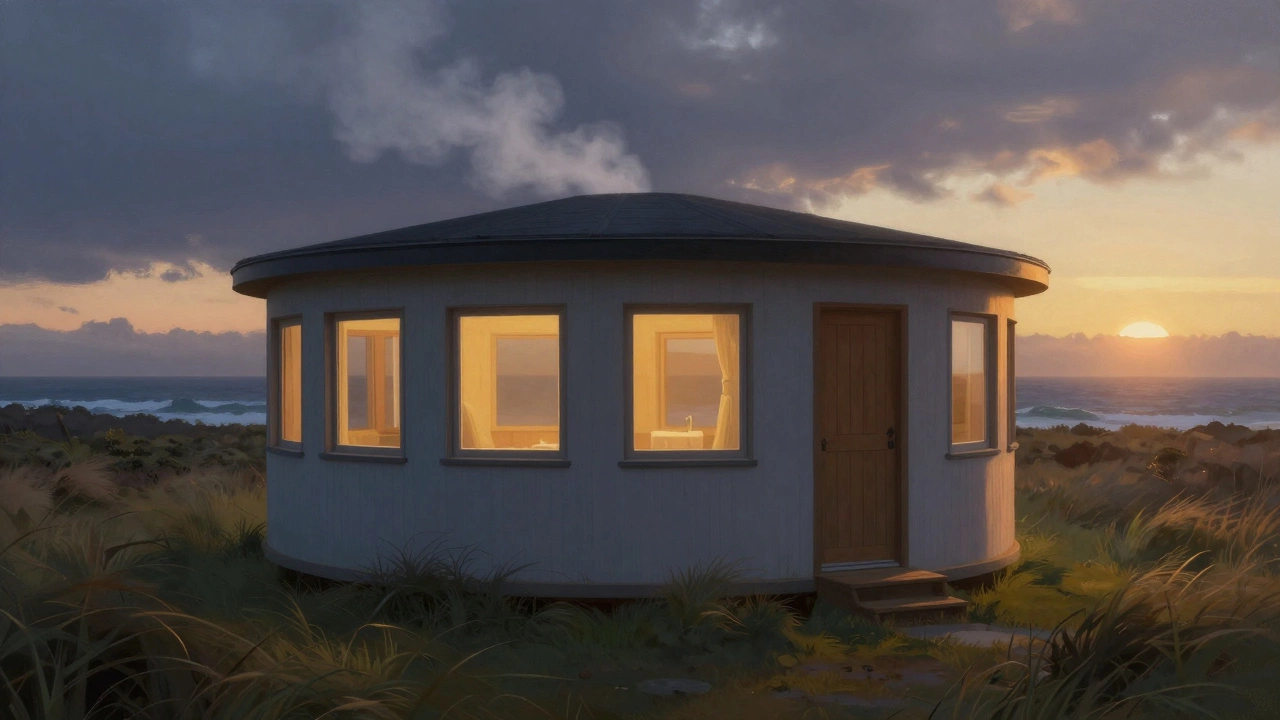
Are there downsides?
Yes, but they’re manageable.- Furniture doesn’t fit perfectly: You can’t just shove a 2-meter sofa against a curved wall. But that’s not a dealbreaker. Custom-built curved shelving, round tables, and modular furniture solve this. Many owners say they end up with more open, flowing space anyway.
- Permitting can be trickier: Some councils still think round houses are “unusual.” But in places like Devonport, where eco-design is encouraged, you’ll find planners who’ve seen them before. Bring a simple sketch and energy model-it helps.
- Resale perception: Not everyone wants a round house. But buyers who care about sustainability and low running costs? They’ll pay more. Listings for eco-round cottages in New Zealand are selling 12% faster than conventional ones, according to Real Estate Institute data from late 2024.
What other shapes come close?
If a full circle feels too radical, here are two other efficient shapes:| Shape | Surface Area Efficiency | Construction Difficulty | Energy Savings vs. Rectangle | Best For |
|---|---|---|---|---|
| Round / Dome | Best (100%) | Moderate | 25-30% | Off-grid, high-wind areas |
| Hexagon | Very Good (90%) | Easy | 18-22% | First-time builders, budget projects |
| Square / Rectangle | Poor (Baseline) | Easy | 0% | Traditional builds, resale-focused |
| Octagon | Good (85%) | Moderate | 15-18% | Those wanting symmetry without curves |
Hexagons are a great middle ground. They’re close to circular in efficiency but use straight walls and right angles, making them easier to build with standard materials. Many tiny home builders in the South Island use hexagonal floor plans for exactly this reason.
Final thought: It’s not about being weird-it’s about being smart
The most economical house shape isn’t chosen because it looks cool. It’s chosen because it uses less stuff, wastes less energy, and lasts longer. In an age where energy prices keep rising and climate risks grow, building smarter isn’t a trend. It’s survival. If you’re planning an eco-friendly cottage, start with the shape. Don’t pick the one that matches your Pinterest board. Pick the one that keeps you warm in winter, cool in summer, and saves you thousands over time. The round house isn’t the future. It’s the most practical option we’ve had all along.Is a round house cheaper to build than a rectangular one?
Yes, typically. While custom curved walls might cost more per meter, you use 15-20% less total material, require less labor for framing, and avoid expensive roof angles. Overall, a well-designed round cottage can cost 10-18% less to build than a rectangular one of the same size, especially when you factor in reduced waste and faster construction.
Do round houses get cold in winter?
Not if they’re built right. The key is insulation and sealing. A round house with proper wall and roof insulation (like hempcrete, cellulose, or rigid foam) retains heat better than a rectangular one because it has less surface area for heat to escape. Many owners in Southland and Fiordland report consistent indoor temperatures without supplemental heating.
Can you add extensions to a round house?
Yes, but it’s easier to plan for it early. You can add a small rectangular annex for a bathroom or storage, or build a curved extension that matches the main shape. Avoid sharp angles where the new section meets the circle-it creates thermal bridges. Many builders use a half-dome or curved pod design for additions.
Are round houses harder to sell?
Not anymore. In eco-conscious markets like Nelson, Queenstown, and Devonport, unique, energy-efficient homes are in high demand. Buyers who care about low bills and sustainability often pay a premium. The real challenge is finding lenders or appraisers unfamiliar with non-standard designs-but that’s changing fast as green building becomes mainstream.
What’s the best material for a round cottage wall?
Hempcrete, rammed earth, and insulated concrete forms (ICFs) are top choices. Hempcrete is lightweight, breathable, and carbon-negative. Rammed earth has high thermal mass, keeping interiors stable. ICFs are faster to install and give excellent insulation ratings (R-20+). Avoid standard timber framing with fiberglass insulation-it’s inefficient for curved walls and prone to gaps.